

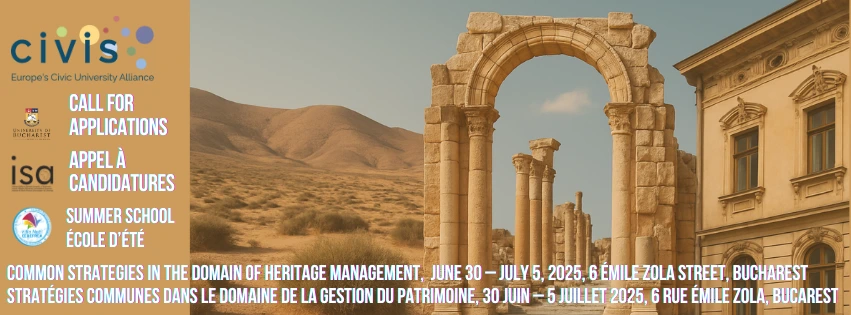
FR
Appel à candidatures école d’été « Stratégies communes dans le domaine de la gestion du patrimoine »
30 juin – 5 juillet 2025, 6, Rue Émile Zola, Bucarest
Contexte :
Cette école d’été est mise en œuvre dans le cadre du projet Configurer des stratégies communes de développement pour un avenir durable dans le contexte de la gestion du patrimoine. Un cadre de collaboration Europe-Afrique dans le contexte régional contemporain, déployé et financé par l’alliance CIVIS et ses partenaires. Le projet se déroulera en plusieurs phases et sera organisé au Maroc et en Roumanie, selon la structure suivante :
1. La journée d’étude Patrimoine partagé / Shared Heritage de Casablanca (Maroc) à 20 mai au 25 mai 2025 ;
2. L’école d’été Stratégies communes dans le domaine de la gestion du patrimoine / Common Strategies in the Domain of Heritage Management à Bucarest (Roumanie) du 30 juin au 5 juillet 2025.
Argument :
Le contexte global des crises cumulatives (économiques, écologiques et sociales) met en évidence les paradoxes entre le développement économique et la préservation du patrimoine. Ces défis imposent de repenser les cadres législatifs et les pratiques de gestion afin de concilier, de manière systématique, les exigences de développement et la sauvegarde d’un patrimoine commun, tant culturel que naturel.
Dans ce cadre, l’école d’été s’inscrit dans l’axe de recherche « Patrimoine (dans les sociétés) en crise. Les polycrises » – piloté depuis 2024 en collaboration avec les enseignants-chercheurs du réseau CIVIS. Cet événement, qui s’inscrit dans un projet Europe–Afrique plus large, vise à offrir un espace de réflexion et de formation pour approfondir la compréhension des enjeux liés à la gestion complexe du patrimoine matériel et immatériel, tout en soulignant l’importance de l’environnement géographique, des contextes locaux et des signifiants sociaux qui y sont liés pour la préservation du patrimoine culturel et naturel, mais aussi pour son intégration fonctionnelle dans les configurations économiques de développement.
Questions méthodologiques à explorer :
Nous nous proposons de répondre à plusieurs questions sans exhaustivité :
1. Comment quantifier et modéliser le compromis entre le développement économique et la préservation du patrimoine, et surtout, comment transmettre ces concepts théoriques aux étudiants de manière claire et accessible ?
2. Quelles approches d’optimisation multi-objectifs (incluant l’analyse des coûts d’opportunité, les courbes de Pareto et la gestion des risques) peuvent être enseignées par des ateliers pratiques pour permettre aux étudiants d’identifier les segments du patrimoine valorisables sans compromettre leur l’intégrité ?
3. Comment intégrer de manière systématique des analyses qualitatives et quantitatives dans l’évaluation des politiques de gestion du patrimoine tout en adaptant les méthodes scientifiques aux contextes culturels et locaux, afin de répondre aux enjeux liés aux polycrises contemporaines ?
4. Quelles méthodes pédagogiques innovantes, inter- et transdisciplinaires peuvent être mises en œuvre pour favoriser l’apprentissage actif et efficace et pour renforcer l’échange de pratiques entre étudiants et chercheurs ?
Objectifs :
1. Renforcer la formation des étudiants de master et de doctorat en leur transmettant des outils théoriques et pratiques pour comprendre et analyser le compromis entre le développement économique et la préservation du patrimoine dans le contexte des polycrises contemporaines.
2. Favoriser l’échange interdisciplinaire entre étudiants et chercheurs par le biais d’ateliers pratiques, d’études de cas et de débats, afin de stimuler une réflexion collective et de promouvoir le partage d’expertises dans la gestion du patrimoine.
3. Développer des approches pédagogiques innovantes qui combinent enseignements théoriques et applications pratiques, permettant aux participants d’acquérir une compréhension concrète des enjeux liés à la gestion du patrimoine et à la préservation dans le contexte de crises multiples et cumulatives.
Participants visés :
Cette école d’été est destinée aux étudiants CIVIS en mobilité à l’Université de Bucarest, aux bénéficiaires des bourses de recherche « Eugen Ionescu » financées par l’AUF, ainsi qu’aux étudiants en master ou doctorat des universités roumaines et des universités membres CIVIS. La participation se fera pour les étudiants roumains en présentiel, à Bucarest. Les étudiants des universités membres CIVIS (Europe et Afrique) pourront suivre l’école d’été en ligne.
Domaines de recherche :
• Gestion du patrimoine
• Législation du patrimoine
• Développement durable
• Histoire du patrimoine
• Économie et sciences sociales
• Études culturelles et européennes/africaines
Cette sélection vise à promouvoir un échange de compétences et de perspectives dans un cadre interdisciplinaire.
Conditions d’éligibilité :
Les étudiants qui souhaiteraient participer à ce programme universitaire :
1. Doivent avoir une bonne compréhension du français et/ou de l’anglais ;
2. Peuvent s’inscrire en envoyant leur CV et une lettre de motivation aux adresses e-mail suivantes : simona.corlanioan@istorie.unibuc.ro ; larissa.luica@unibuc.ro ; simona.necula@unibuc.ro.
Ce programme universitaire à dimension internationale permettra aux étudiants participants de valider 3 ECTS.
Date limite d’inscription : 16 juin 2025
Partenaires :
Institut d’Études Africaines (ISA)
Centre Régional Francophone d’Études Avancées en Sciences Sociales (CEREFREA)
Université de Sfax (Tunisie)
Université de Casablanca (Maroc)
Université de Glasgow (Royaume-Uni)
Université d’Athènes (Grèce)
Comité scientifique :
Pr. Leila Maziane, Université Hassan II Casablanca, Maroc
Pr. Sanaa Hassab, Université Hassan II Casablanca, Maroc
Pr. Abdelwahed Mokni, Université de Sfax, Tunisie
Pr. Mouhamed Ly, IFAN, Université Cheikh Anta Diop, Dakar, Sénégal
Pr. Jelmer Vos, Université de Glasgow, Grande- Bretagne
Pr. Dimitris Gouscos, Université nationale et capodistrienne d’Athènes
Pr. Simona Corlan Ioan, Institut d’Etudes Africaines, Université de Bucarest
Comité d’organisation :
Simona Corlan-Ioan, Coordinatrice CEREFREA
Irina Balotescu, Chercheuse Institut de Recherche de l’Université de Bucarest – ICUB
Simona Necula, Chercheuse, CEREFREA
Larissa Luica, Chercheuse CEREFREA
Alexandru Vasiliu, Lecteur associé, Université de Bucarest
EN
Call for Applications Summer School “Common Strategies in the Domain of Heritage Management”
June 30 – July 5, 2025, 6 Rue Émile Zola, Bucharest
Context:
This summer school is implemented through the Configuring Common Developmental Strategies for a Sustainable Future in the Heritage Management Context. A Europe–Africa Collaborative Framework in the Contemporary Regional Context project, which is deployed and funded by the CIVIS alliance and its partners. The project is multi-phased and will be organised in Tunisia, Morocco, and Romania, in correlation with the following structure:
1. The workshop Shared Heritage / Patrimoine partagé in Casablanca (Marocco) from May 20 to 25, 2025;
2. The summer school Common Strategies in the Domain of Heritage Management / Stratégies communes dans le domaine de la gestion du patrimoine in Bucharest (Romania) from June 30 to July 5, 2025.
Argument:
The global context of cumulative crises (economic, ecological and social) highlights the paradoxes between economic development and heritage preservation. These challenges require a rethinking of legislative frameworks and management practices in order to systematically reconcile development requirements with the safeguarding of a common heritage, both cultural and natural.
In this context, the summer school is part of the research axis Heritage (in societies) in crisis. The polycrises – coordinated since 2024 in collaboration with the CIVIS research network. This event, which is part of a broader Europe–Africa project, aims to provide a space for reflection and training to deepen the understanding of issues related to complicated management of tangible and intangible heritage, while highlighting the importance of the geographical environment, local contexts, and social signifiers that are connected for the preservation of cultural and natural heritage, but also to its functional integration in developmental economic configurations.
Methodological questions to be explored:
We propose to address several questions, without exhaustiveness:
1. How can we quantify and model the trade-off between economic development and heritage preservation, and, above all, how can these theoretical concepts be clearly and accessibly communicated to students?
2. Which multi-objective optimization approaches (including opportunity cost analysis, Pareto curves, and risk management) can be approached through practical workshops to enable students to identify segments of heritage that can be capitalised without compromising their integrity?
3. How can qualitative and quantitative analyses be systematically integrated into the evaluation of heritage management policies, while adapting scientific methods to cultural and local contexts, in order to address the challenges posed by contemporary polycrises?
4. Which innovative, inter- and transdisciplinary pedagogical methods can be implemented to foster active and effective learning and to enhance the exchange of practices between students and researchers?
Objectives:
1. Strengthen the training of Master’s and Doctoral students by providing them with theoretical and practical tools to understand and analyse the trade-off between economic development and heritage preservation in the context of contemporary polycrises.
2. Foster interdisciplinary exchange between students and researchers through practical workshops, case studies, and debates, in order to stimulate collective reflection and promote the sharing of expertise in heritage management.
3. Develop innovative pedagogical approaches that combine theoretical instruction with practical applications, enabling participants to acquire a concrete understanding of the challenges related to heritage management and preservation in the context of multiple and cumulative crises.
Targeted participants:
This summer school is intended for CIVIS students on mobility at the University of Bucharest, beneficiaries of the “Eugen Ionescu” research grants funded by AUF, as well as Master’s and Doctoral students from Romanian and CIVIS universities. Participation will be in-person for students from Bucharest. Students from CIVIS (Europe and Africa) will be able to follow the summer school online.
Research areas:
• Heritage Management
• Heritage Legislation
• Sustainable Development
• Heritage History
• Economics and Social Sciences
• Cultural and European/African Studies
This selection aims to promote an exchange of skills and perspectives within an interdisciplinary framework.
Eligibility conditions:
Students wishing to participate in this academic programme:
1. Must have a good command of English and/or French;
2. Can apply by sending their CV and a motivation letter to the following e-mail addresses: simona.corlanioan@istorie.unibuc.ro ; larissa.luica@unibuc.ro ; simona.necula@unibuc.ro.
This international academic program will allow participating students to earn 3 ECTS.
Registration deadline: 16 juin 2025
Partners:
Institute of African Studies (ISA), University of Bucharest
Regional Francophone Center for Advanced Studies in Social Sciences (CEREFREA)
University of Sfax (Tunisia)
University of Casablanca (Morocco)
University of Glasgow (United Kingdom)
National and Kapodistrian University of Athens University of Athens
Scientific committee:
Leila Maziane, Université Hassan II Casablanca, Maroc
Sanaa Hassab, Université Hassan II Casablanca, Maroc
Abdelwahed Mokni, Université de Sfax, Tunisie
Mouhamed Ly, IFAN, Université Cheikh Anta Diop, Dakar, Sénégal
Jelmer Vos, University of Glasgow (United Kingdom)
Dimitris Gouscos, National and Kapodistrian University of Athens
Simona Corlan Ioan, Institute of African Studies (ISA), University of Bucharest
Organizing committee:
Simona Corlan-Ioan, CEREFREA Coordinator
Irina Balotescu, Researcher, Institute of Research, University of Bucharest – ICUB
Simona Necula, Researcher, CEREFREA
Larissa Luica, Researcher, CEREFREA
Alexandru Vasiliu, Associate lecturer, University of Bucharest
